Your market stall sells out three weekends in a row in November, and by mid December your sales for October to December pass $30,000. Under the Canada Revenue Agency's single quarter test, GST/HST applies from the sale that crosses that line. If you only notice in February, those holiday sales were already paid without the tax.
The short answer: you must register and charge GST/HST once your taxable sales go over $30,000 in one calendar quarter or over four consecutive calendar quarters. The rate follows your customer, not you: from 5% GST in Alberta to 13% HST in Ontario and 15% HST in New Brunswick. Show the rate on every invoice, and add your registration number on sales of $100 or more.
Key takeaways
- The small supplier limit is $30,000 of taxable sales, tested over one calendar quarter and over any four consecutive calendar quarters.
- Charge the rate of the province where the goods are delivered or, for most services, where the customer's address is: from 5% GST to 15% HST.
- A sole proprietor with a December 31 year end who files annually pays by April 30 and files the return by June 15.

Do you have to charge GST/HST yet?
A business under the limit is a small supplier: it does not have to register or charge GST/HST. There are three ways to stop being one.
- One big quarter. If your taxable sales go over $30,000 in a single calendar quarter, you are no longer a small supplier from the sale that takes you over. You charge GST/HST on that sale and every one after it.
- Four quarters added up. If no single quarter passes $30,000 but four consecutive quarters together do, you stop being a small supplier at the end of the month after the quarter in which you went over. You start charging from your first sale after that.
- Your line of work. Self employed taxi operators and ride sharing drivers must register from their first fare, whatever their sales.
Calendar quarters run January to March, April to June, July to September and October to December. The CRA's examples say you have to register within 29 days of your effective date of registration.
Worked example. A candle maker sells $6,000, $7,000, $8,000 and $12,000 in the four quarters of the year. No quarter passes $30,000, but together they reach $33,000 in the October to December quarter. She stops being a small supplier at the end of January and charges GST/HST from her next sale.
You can also register voluntarily before you reach $30,000, mainly to claim back the GST/HST you pay on business costs as input tax credits. The trade off: prices go up for customers who cannot claim the tax back.
GST/HST rates by province and territory
Provinces with HST collect one combined tax through the CRA. Elsewhere you charge 5% GST, and provincial sales tax is a separate registration with that province.
| Province or territory | GST/HST you charge | Provincial rate listed separately by the CRA |
|---|---|---|
| Alberta | 5% GST | None |
| British Columbia | 5% GST | 7% PST |
| Manitoba | 5% GST | 7% PST |
| New Brunswick | 15% HST | Included in HST |
| Newfoundland and Labrador | 15% HST | Included in HST |
| Northwest Territories | 5% GST | None |
| Nova Scotia | 14% HST (since April 1, 2025) | Included in HST |
| Nunavut | 5% GST | None |
| Ontario | 13% HST | Included in HST |
| Prince Edward Island | 15% HST | Included in HST |
| Quebec | 5% GST | 9.975% |
| Saskatchewan | 5% GST | 6% PST |
| Yukon | 5% GST | None |
To work out the tax on any price, use our GST/HST calculator.
Which province's rate to charge
The CRA calls this the place of supply. These rules cover most small business sales.
- Goods you ship or deliver: charge the rate of the province the goods are sent or delivered to. A Toronto shop that mails an order to Calgary charges 5% GST, not 13% HST.
- Goods picked up at your counter: the province where the customer takes them is the place of supply, so a walk in sale in Halifax is 14% HST.
- Services: if you get the customer's address in the normal course of business, charge the rate of the province of that address. A Winnipeg bookkeeper with a client in Moncton charges 15% HST.
- Personal services done in person, such as a haircut, generally follow the province where the service is performed.
Basic groceries and other zero rated supplies are taxed at 0%, and exempt supplies carry no GST/HST at all.
What your invoices and receipts must show
The CRA says you must tell customers whether GST/HST applies, show the rate, and either list the tax separately or state that the total includes GST/HST. For HST, show the single combined rate; do not split it into federal and provincial parts.
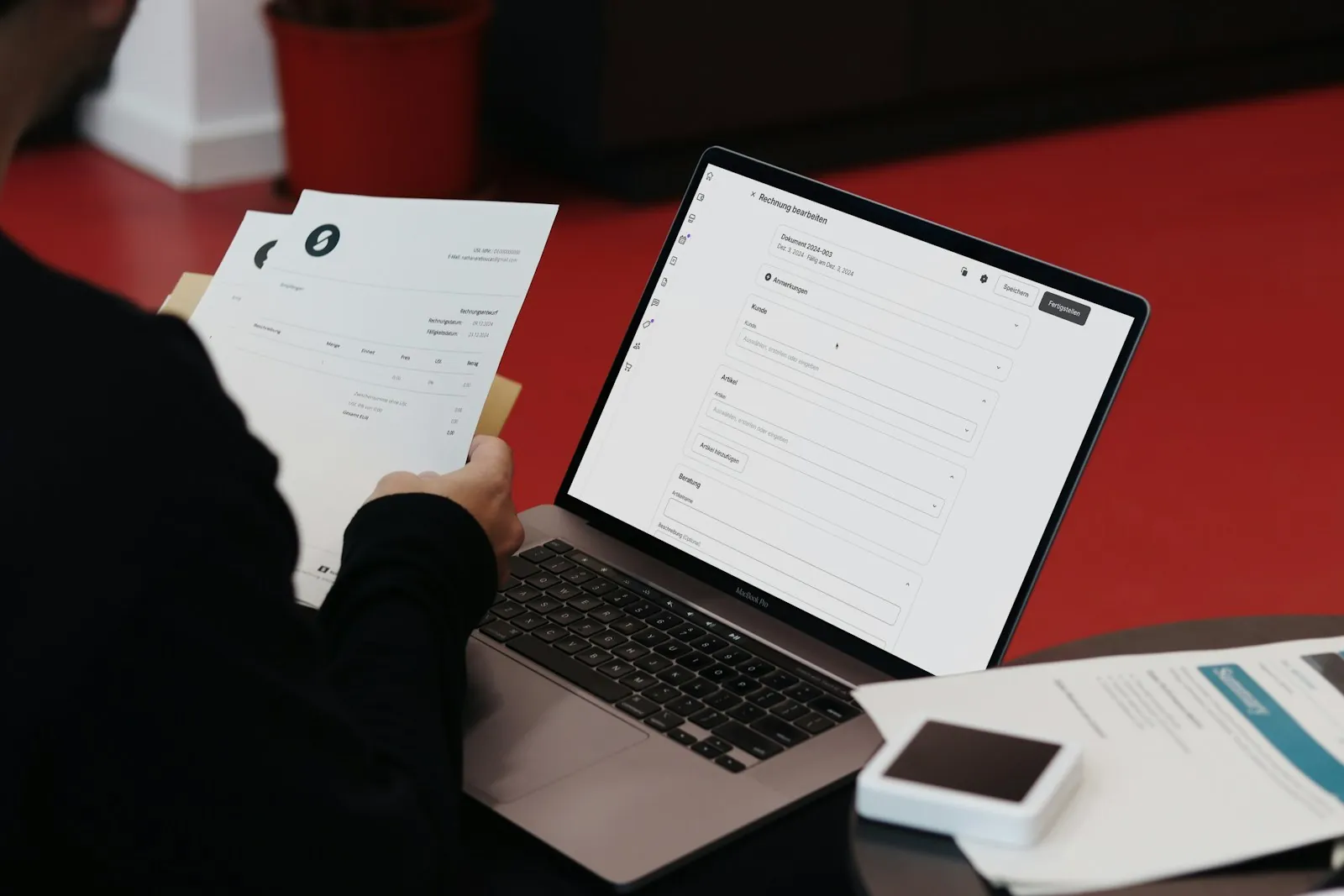
Business customers need more detail to claim their input tax credits, and the CRA sets it by the size of the sale:
| Total sale | What the invoice or receipt shows |
|---|---|
| Under $100 | Your business or trading name, the invoice date, the total paid or payable |
| $100 to $499.99 | All of the above, plus the GST/HST amount or rate, which items are taxable or exempt if both appear, and your GST/HST registration number |
| $500 or more | All of the above, plus the buyer's name or trading name, a short description of what you sold, and the payment terms |
Copy and paste invoice block. Put this under your line items and fill in the brackets:
Invoice to: [Customer name or business name]
Invoice date: [date] Payment terms: [Due in 30 days]
Description: [What you sold or did]
Subtotal: $[amount]
[HST 13% / GST 5%]: $[tax amount]
Total: $[amount plus tax]
GST/HST registration number: [123456789 RT0001]
Many invoicing apps fill this in once you add your rate and number in the settings. Our guide to free invoicing software in Canada compares the options.
Filing and paying: the dates that matter
Once registered, you file returns and pay the net tax: what you collected, minus the input tax credits you can claim.
- Annual filing is the default if your annual taxable sales are $1,500,000 or less. You can choose to file quarterly or monthly instead.
- Sole proprietors with a December 31 year end and business income pay by April 30 and file by June 15.
- Other annual filers, including most corporations, file and pay three months after their fiscal year end. A December 31 year end means March 31.
- Monthly and quarterly filers file and pay one month after the period ends. Most registrants must file online.
The Quick Method. If your annual worldwide taxable sales, including GST/HST, are $400,000 or less, you may be able to elect the Quick Method, where you remit a set percentage of your tax included sales. In Ontario that is 8.8% for a service business and 4.4% for a retailer; a service business in a 5% GST province remits 3.6%. You also get a 1% credit on the first $30,000 of eligible sales each year. Bookkeepers, accountants, lawyers and tax preparers cannot use it.
Example: an Ontario service business bills $50,000 plus $6,500 HST, so $56,500 in total. Under the Quick Method it remits 8.8% of $56,500, which is $4,972, minus the $300 credit, so $4,672. Under the regular method it would remit the $6,500 minus its input tax credits, so ask your accountant to compare both before you elect.
Common problems and fixes
- You went over the limit months ago. Register now. The CRA has a process for backdating a registration by more than 30 days, and an accountant can help you work out the tax owed on past sales.
- You charged your home province's rate on out of province orders. Update your checkout or invoice settings to use the shipping or billing address, and correct future invoices.
- Your number is missing from invoices over $100. Add it to your template once and reissue those invoices to business customers who ask.
- You spent the tax. The GST/HST you collect is not your money. Move it into a separate savings account the day each invoice is paid, so the payment to the CRA is there when it is due.
For the software that tracks all of this, see our free accounting software guide or browse the software hub. This guide explains the CRA's published rules; it is not tax advice for your situation.
Frequently asked questions
Do I charge GST/HST if I make less than $30,000?
Not unless you register voluntarily. If your taxable sales stay at $30,000 or less in every calendar quarter and over every four consecutive quarters, you are a small supplier and do not have to register, except for self employed taxi and ride sharing drivers.
What is the HST rate in Ontario?
13%. Nova Scotia is 14% since April 1, 2025, and New Brunswick, Newfoundland and Labrador and Prince Edward Island are 15%.
Do I charge my province's rate or my customer's?
Usually your customer's. Goods are taxed at the rate of the province they are delivered to, and most services at the rate of the province of the customer's address.
When is a sole proprietor's GST/HST return due?
If you file annually, have a December 31 year end and had business income, payment is due April 30 and the return is due June 15. A due date on a weekend or CRA holiday moves to the next business day.
Sources
- Canada Revenue Agency: When to register for and start charging the GST/HST
- Canada Revenue Agency: GST/HST calculator and rates
- Canada Revenue Agency: GST/HST and place of supply rules
- Canada Revenue Agency: Charge and collect the GST/HST, receipts and invoices
- Canada Revenue Agency: General Information for GST/HST Registrants (RC4022)
- Canada Revenue Agency: GST/HST reporting requirements and deadlines
- Canada Revenue Agency: Quick Method of Accounting for GST/HST (RC4058)
- Canada Revenue Agency: Request a GST/HST registration to be backdated by more than 30 days