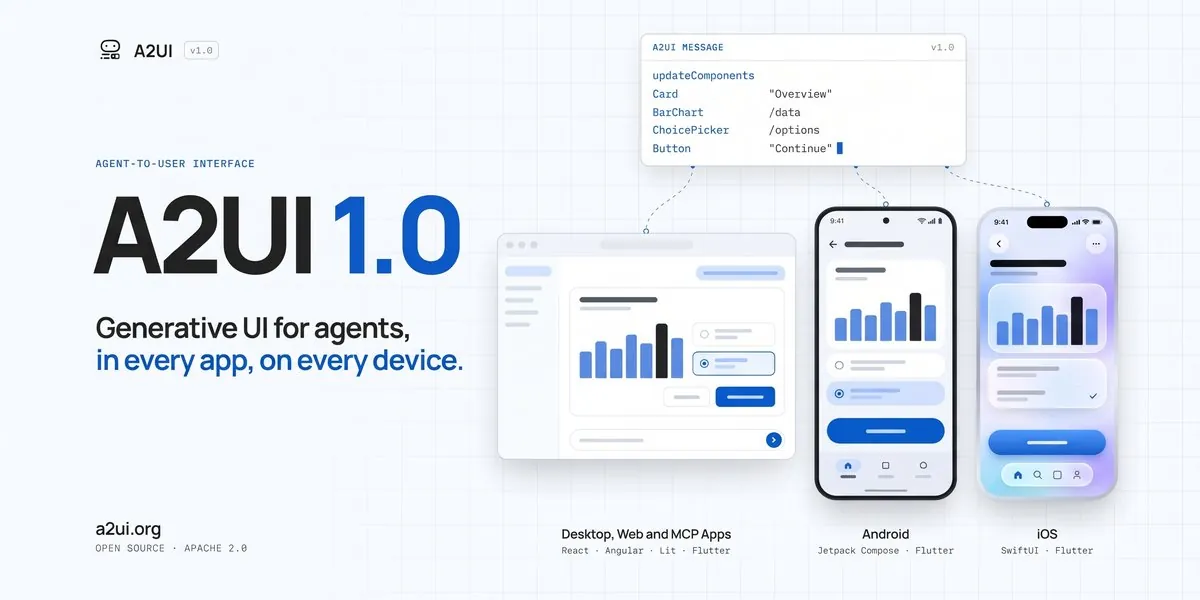


Ask an AI assistant to book a table today and you get a wall of text, then you type your answers back. On November 11, 2026, Google released A2UI 1.0, an open protocol that lets the agent answer with a real screen instead: a booking form, a date picker or a chart you can tap.
Version 1.0 is the first stable release. Google says the agent describes what to show, and your app draws it with its own native components, so the result matches your design and only uses parts you allow.
Key facts
- A2UI 1.0 is the first stable version of Google's open protocol for generative UI, released November 11, 2026.
- Open source renderers cover React, Angular, Lit, Flutter and SwiftUI; Jetpack Compose 1.0 is coming soon.
- Google does not list a price; the protocol and renderer SDKs are open.
What A2UI 1.0 does
A2UI sits between an AI agent and the app a person uses. The agent sends a description of the interface, and the app renders it. Google lists these changes in 1.0:
- Two way function calls. A component can call back while you use it, so a reservation picker can check availability on the spot.
- Accessibility support and extensions for extra metadata.
- Streaming. The screen fills in while the agent works.
- Agent SDKs for TypeScript, Dart and Python that help models produce valid screens and correct errors.
- Server side data binding, so sensitive values never reach the model.
The web and Flutter renderers also work inside MCP Apps, which Google says lets A2UI screens appear in assistants such as Claude and Gemini.
Who can use it and what it costs
Developers can start today from a2ui.org and the GitHub repo. Packages include @a2ui/react, @a2ui/angular, @a2ui/lit and @a2ui/agent on npm, a2ui_flutter on pub.dev and a2ui-agent-sdk on PyPI. Google describes the protocol and renderers as open and does not list a fee.
Google already uses A2UI in Gemini Notebook and lets organisations register agents in Gemini that reply with A2UI, at version 0.9.1 for now. Gemini Enterprise agents can use it, with a 1.0 upgrade in progress. Named partners include Atlassian, which shows interactive cards inside Jira work items, plus Alation, ByteDance's Lynx team, Bloomberg and CopilotKit.
What it means for a small business
If you run a shop or a service business, you will not install A2UI yourself. You will meet it inside tools. A chatbot on a booking site could show a slot picker rather than ask you to type a date. A support agent could show an order card with a "return this item" button.
If you build websites for clients, this one deserves an hour of reading. A few starting points:
- Clients who want an AI assistant on their site may soon ask for buttons and forms in the chat, not text replies.
- A2UI lets you keep the client's own components and styles, so the chat matches the rest of the site.
- You control the list of components the agent may use, which limits what an agent can put on screen.
Our take
Based on Google's announcement, not on hands on testing: A2UI 1.0 matters more to the people who build sites and apps than to their clients, at least for now. A stable spec, renderers for the main web frameworks and support inside Claude and Gemini give it a real head start. Gemini itself still runs 0.9.1, though, and Android Compose support has not reached 1.0. If you build chat features for clients, try the quickstart on a test project before you promise it to anyone.
Frequently asked questions
What is A2UI?
A2UI is Google's open protocol for generative UI. It lets an AI agent answer with interactive screens, such as forms and charts, that your app draws with its own components.
Is A2UI free?
Google describes the protocol and renderer SDKs as open and lists no price. Running the AI agent behind it may cost money, depending on the model you use.
Which frameworks does A2UI 1.0 support?
React, Angular, Lit, Flutter and SwiftUI. Jetpack Compose is at version 0.9.1, with 1.0 support coming soon.