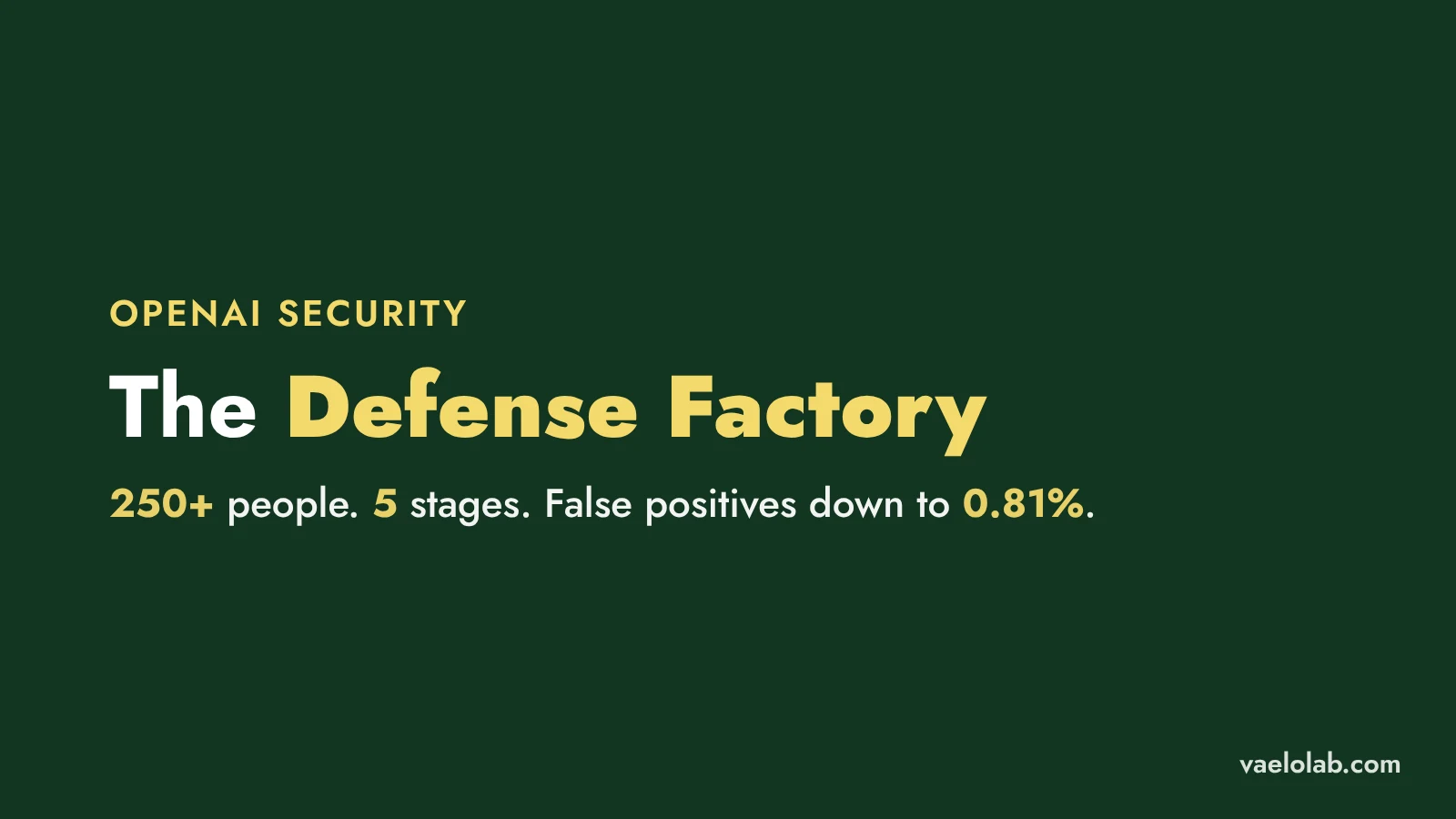
OpenAI pulled more than 250 people into a security sprint and came out with a method it calls the Defense Factory: AI agents that keep finding, checking and fixing security holes in its own code. It published the approach as a web page and a free playbook PDF in the first week of September 2026.
The Defense Factory is a working method, not a product you can buy. Posts circulating this week call it a new OpenAI product launch. OpenAI's own pages describe it as its internal approach, with a playbook other teams can copy.
Key facts
- Five stage loop: inventory, discovery, dynamic validation, ownership assignment, verified remediation.
- After runtime checks, false positives fell to 0.81% and rolled back fixes to 0.53%.
- The playbook is a free PDF; access to OpenAI's cyber models goes through Daybreak applications.
What the Defense Factory does
Agents work inside tools a security team already uses, such as GitHub, GitLab, Snyk, Semgrep, Jira and Linear, and test code in isolated environments. Each finding moves through five steps:
- Inventory: list what code and services exist.
- Discovery: scan for possible weaknesses.
- Dynamic validation: run the code to prove the problem is real.
- Ownership assignment: route the finding to the team that owns the code.
- Verified remediation: fix it and confirm the fix works.
OpenAI shared numbers from its sprint. The team covered more than 100 service areas and closed 53 urgent or high priority issues on the first day. Agents flagged 37% of findings as duplicates, and only 19.5% of findings reproduced when run. Accepted ownership assignments rose to 90.6%. OpenAI adds that these sprint figures are not measured progress or savings.
Who can use it and what it costs
Anyone can read the page and download the playbook. It suggests a six week surge with an executive sponsor, weekly reviews and reusable agent skills such as scan, triage, fix and verify. OpenAI lists no price for the method. Its advanced cyber models sit behind Daybreak, a program for approved defenders. OpenAI's Daybreak announcement of September 3, 2026 committed US$1 billion in subsidized access, training and support for groups such as water and power operators, local governments, community banks, nonprofits and open source maintainers.
What it means for a small business
You will not run a 250 person sprint. Two ideas still carry over. First, a scanner warning is a lead, not a verdict: in OpenAI's run, fewer than one in five findings held up when tested. Second, every finding needs a named owner, or it sits in a list forever. If someone builds or hosts your site, ask them who owns security fixes and how fast they apply them.
Our take
Based on OpenAI's published pages, not our own testing: the playbook is written for companies with security teams, and most owners can skip it. The validation step is the part worth stealing. Ask your developer to prove a problem is real before charging you to fix it, and to show the fix works afterwards.
Frequently asked questions
Is the Defense Factory an OpenAI product?
No. OpenAI describes it as its own continuous, agent first way of finding and fixing vulnerabilities, published with a free playbook.
How do I get OpenAI's cyber models?
OpenAI points organizations doing authorized defensive work to apply for Daybreak access.
Does the Defense Factory cost money?
OpenAI lists no price for the method or the playbook. Daybreak access is subsidized for eligible groups under OpenAI's US$1 billion commitment.