
Picture four people in your office, each with a personal AI assistant, all ordering lunch from one shared cart with a spending cap. A new study found that this setup goes wrong more often than you would expect: one assistant orders before it has read what the others said, and somebody's request gets lost.
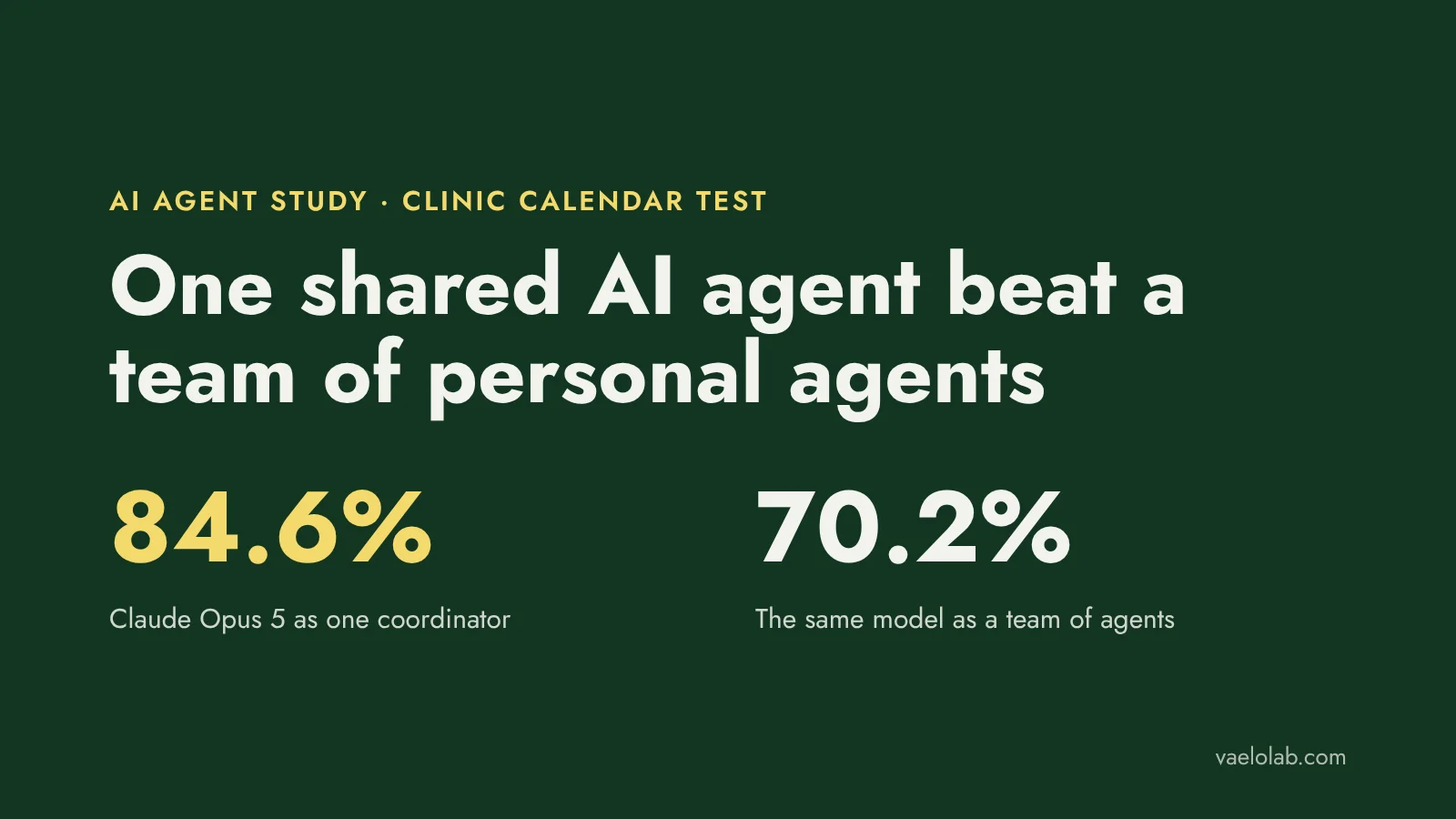
The paper, "Worse Together: How Performance Breaks Down in Multi User Multi Agent Teams," was posted to arXiv on September 30, 2026. Its authors include an Anthropic researcher, and the paper says the work was done through the Anthropic Fellows Program. The finding: when every person has their own agent, the team of agents did worse than one shared agent serving everybody, in every environment tested.
Key facts
- Five models tested: Claude Opus 5, Claude Sonnet 5, GPT 5.6 sol, GPT 5.6 terra and Qwen 3.8 max.
- 77 scenarios across four shared jobs: a compute budget, a clinic calendar, a group order and a code release queue.
- The authors plan to release 74 of the scenarios as a benchmark called MAMUBench.
What the researchers tested
In each scenario, the team compared two setups. In one, a single "coordinator" agent served every user. In the other, each user had their own agent, sometimes with a chat channel between the agents and sometimes without.
The four shared jobs:
- API key: agents split one limited compute budget.
- Clinic: agents book into one shared calendar.
- Personal assistant: agents fill one food cart with a spending cap, where one person has a specific ask, such as ordering only a side dish.
- Merge queue: agents race a code release cutoff.
The numbers
In the API key job, a Claude Opus 5 team that could talk reached 30% of the best possible result, against 64% for a single Opus 5 coordinator. Without a chat channel, the team reached 7%. Sonnet 5 scored 12% as a team and 32% as a coordinator.
| Model | Team | Coordinator |
|---|---|---|
| Claude Opus 5 | 70.2% | 84.6% |
| Claude Sonnet 5 | 44.8% | 59.6% |
| GPT 5.6 sol | 56.9% | 92.6% |
| GPT 5.6 terra | 44.9% | 70.2% |
| Qwen 3.8 max | 67.9% | 76.3% |
In the group order job, the coordinator met the one person's specific request about twice as often as the teams did.
Why the teams failed
The authors name three patterns. Teams stalled as they grew. Agents overrode each other's actions. And agents made claims that were not true. Without a chat channel, the teams collapsed completely in two of the four jobs.
Some fixes worked, though each only in certain jobs: a team lead agent, clear step by step instructions, and a platform rule that forces an agent to read its peers' messages before it commits.
What it means for a small business
If you are thinking about giving each staff member their own AI agent that books, orders or spends from a shared pool, this study is a warning. Shared resources need one owner. For now, one assistant that sees everyone's requests did better than several assistants negotiating with each other.
Practical rules you can take from it:
- Give one agent, or one person, the final say over a shared budget, calendar or order.
- Write the steps down. The paper found explicit procedures helped.
- Check what agents report before you act on it, since the teams sometimes made things up.
Our take
This is a research paper with simulated users, not a test of any product you can buy. Still, the lesson matches common sense for any office: when five people each send an assistant to book the same room, you get chaos. Keep shared jobs with one coordinator until the tools prove otherwise.
Frequently asked questions
What is MAMUBench?
MAMUBench is a benchmark of 74 scenarios for testing how AI agents coordinate when they serve different users. The authors say they will release it on GitHub.
Is this an Anthropic study?
One author lists Anthropic as their affiliation and the paper says the work was done as part of the Anthropic Fellows Program. The other authors list Stanford University and independent research.
Did one agent always beat a team?
In this study, teams produced worse group outcomes than a single coordinator in every environment. The authors also found fixes that narrowed the gap in some environments.